
KNOW YOU THE HAND?
Roger Stritmatter - Professor of Humanities Coppin State University

De Vere’s Hand in the Audley End Annotations
In the previous blog, it was shown that the Audley End Unknown annotator was not, as Casson and Rubinstein had assumed, Sir Henry Neville (1564-1615). The books in question do appear to have been moved, in or around 1925, to Audley End from Neville’s Berkshire estate at Billingbear (not, as has sometimes been reported, much earlier). They also do contain a few annotations by Neville, and more by his tutor and long-term associate Sir Henry Savile (1549-1622). But by far the largest and most widely distributed group are by a third party, writing in a very fine italic hand, provisionally labelled the “Audley End Unknown”. At least three readers, then, belonged to a group which shared, read, and annotated the same books (Figure 1).
Who was this mystery annotator? I first learned of the Casson and Rubinstein book at the 2019 annual Shakespeare Oxford Fellowship meeting at the Mark Twain House in Hartford, Ct., from Dr. Jan Scheffer. Having read my PhD dissertation and acquainted himself with the handwriting of Edward de Vere, 17th Earl of Oxford (1550-1604), Scheffer already hypothesized from Casson and Rubinstein’s images that the “Audley End Unknown” might be de Vere. To test this hypothesis my wife Shelly Maycock and I, with the support of the de Vere Society and Dorna Bewley, twice visited Audley End to examine and document the annotations, eventually discovered as many as six books contained notes by the Audley End Unknown writer, and that several of these also contain notes by Savile and Neville.
An axiom of modern forensic handwriting science holds that an individual’s handwriting – at least under normal circumstances – is unique (Srihari et al. 2002), composed of a sequence of markings that possess an identifiable individuality. The individuality of handwriting is a topic in King Lear, a tragicomedy written over four hundred years ago. In Shakespeare’s play, the gregarious, bespectacled sensualist, Gloucester, cannot distinguish between the actual handwriting of his good son Edgar, and the Machiavellian forgeries of his bad son, Edmund. The forger baits his confused father by distinguishing the handwriting from the letter’s wicked contents, which appeal to the concept that a grown child must sometimes usurp control from a declining parent: “It is his hand, my lord; but I hope his heart is not in the contents” (1.2.67-68). Unable to detect either the handwritten forgery, or the verbal dissimulation of his evil son, the epicurean Gloucester is eventually punished by having his eyes put out by Lear’s evil daughter Regan and her sociopathic husband Cornwall (3.7).
Of the three identified Audley End writers, by far the most prolific, and the one of greatest interest to our inquiry, was the Audley End Unknown. An 18,000-word forensic analysis (Stritmatter 2023), published in the Journal of Forensic Document Examination (JDFE), now identifies the writer of these Audley End notes as de Vere. JDFE is an internationally recognised peer-reviewed journal of forensic studies that began in 1987 as the in-house journal of the American Association of Forensic Document Examiners before joining forces with the International Graphonomics Society, founded in 1985 to “promote research into motor control and movement including handwriting.” The journal publishes “many of the most current scientific research papers on handwriting execution and identification.” Published in late 2023, the findings of this study have not been challenged in any serious way.
The JDFE article, “The Audley End Annotations: Applying and Huber and Headrick’s Elements of Handwriting Discrimination to a 16th Century Unknown Document”, details the visual material evidence that confirms this hypothesis (Figure 1).
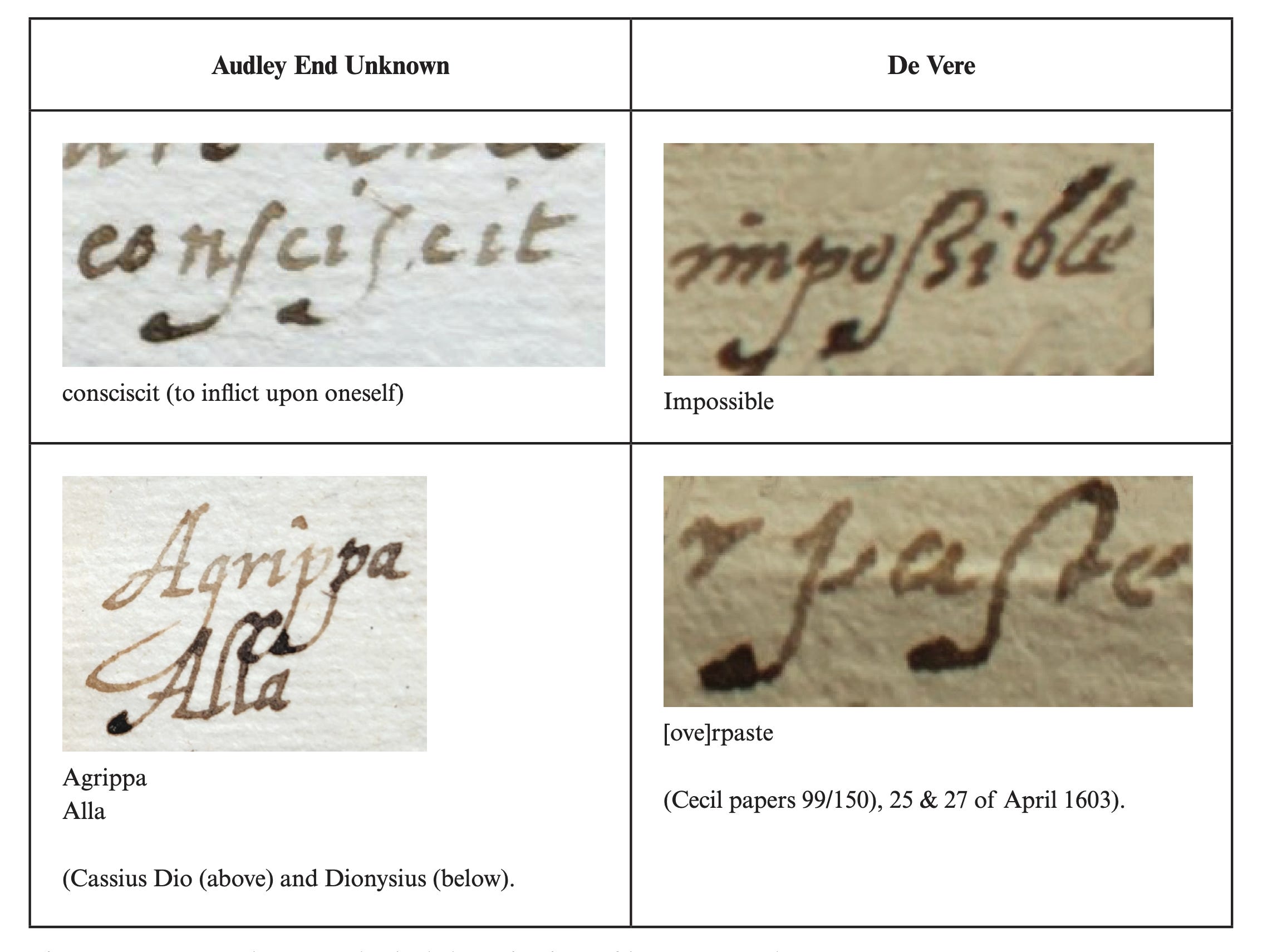
Figure 1. Comparison of handwriting samples from the Audley End Unknown hand (left) and Edward de Vere (right) showing the shared feature of shaded terminations on letters p, s, and A. Reprinted courtesy the Journal of Forensic Document Examination.
The shaded terminations of Figure 1 occur only in the most carefully executed, “calligraphic” samples from both the de Vere and Audley End data bases, but there is no mistaking the comparability of the samples, even though one is written in the limited margins of a book and the other on a full page. The JDFE study covers more than ten standards of comparison. These are first applied to reveal the defects of the Casson-Rubinstein hypothesis of Neville as the annotator. Instead, the evidence eventually proves that de Vere is the annotator responsible for that subset of the annotations that relate in such direct and stunning ways to the Shakespearean ethos found in the plays.
The JDFE study covers more than ten standards of comparison. These are first applied to show the defects of the Casson-Rubinstein hypothesis of Neville as the annotator. Instead, the same evidence verifies that de Vere is the annotator responsible for that large subset of the annotations previously identified as the “Audley End Unknown”, that relate in such direct and stunning ways to the Shakespearean ethos found in the plays. For example, in Figure 2 it is shown that the Audley End and de Vere samples match in five distinct subtypes of the highly variable lower-case letter-p.
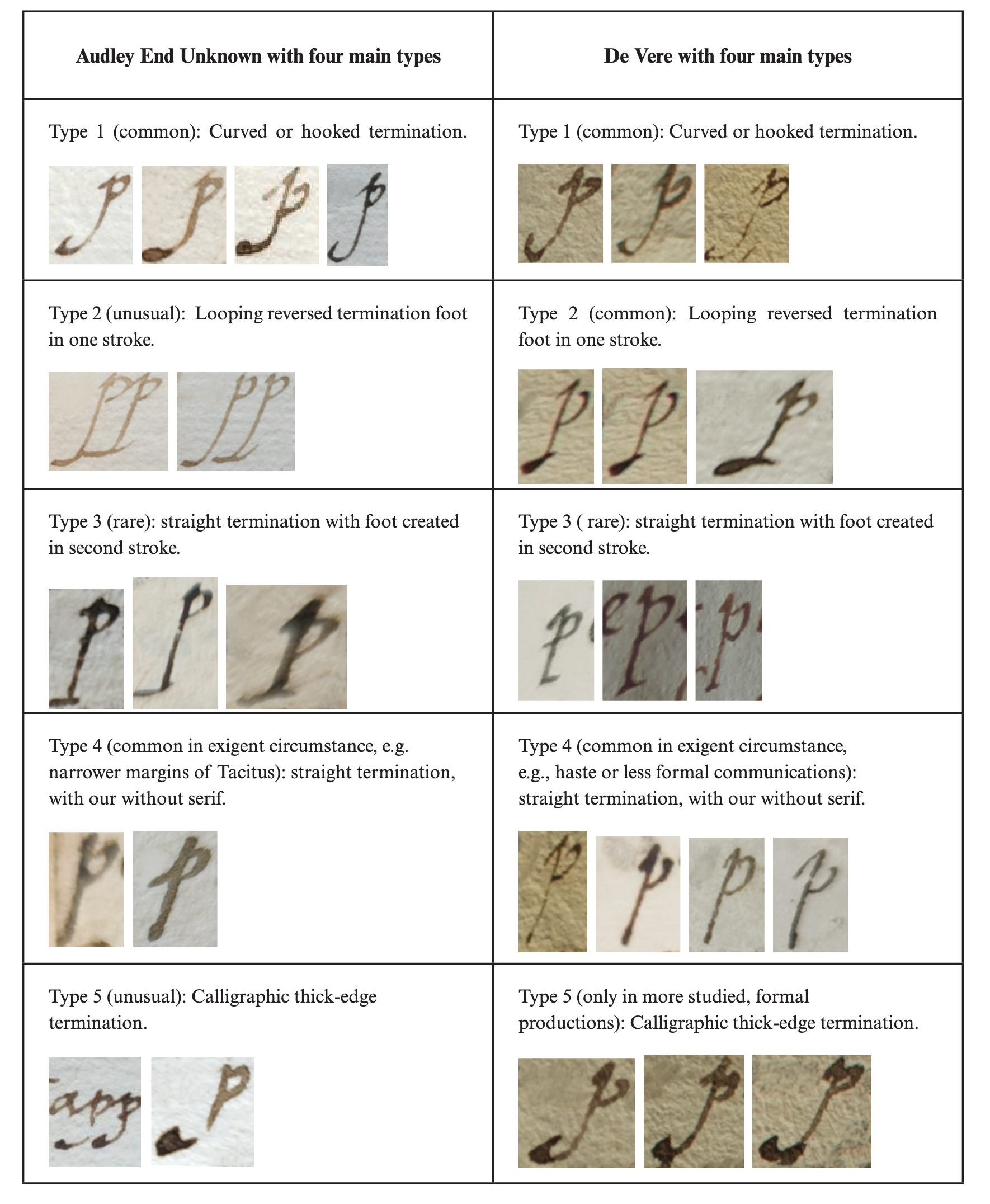
Figure 2. Five variations of the letter P in Audley End and de Vere samples reveal the striking match in range of variation in the letter. While the samples written on a full page show a consistently more pronounced slant, they are in every other regard virtually identical in their construction and range of variation. Reprinted courtesy the Journal of Forensic. Document Examination.
The case for de Vere as the annotator is not merely a forensic one. To start from the most generic considerations in the case, few 16th century English writers could furnish such an elegant, sometimes calligraphic Italic hand like that seen in the Audley End annotations. Even fewer wrote such a hand and also illustrate the profound fluency of both Latin and Greek that is characteristic of the Audley End Unknown sample. The Italic style had only been introduced into England in the 1520s and was by the early 17th century already being superseded by the so-called English Round hand, the precursor of modern cursive handwriting. Even while it lasted, the style was confined to a minority of writers in England, while the dominant hand for most uses remained the English secretary hand, derived from the northern European Gothic script. In 16th century English documents, the Italic hand occurs most commonly in diplomatic correspondence in Italian or French, or for special uses like the signing of a name or stage directions in a theatrical manuscript (the same sorts of purposes that modern italic is still used as a variant of the Roman typeface).
Although his handwriting varies with the formality of the occasion, few English writers employed the Italic script as consistently as de Vere in his surviving correspondence at locations such as Hatfield, the Public Record Office, and the Essex County Library. If he also – as is probable – wrote a secretary hand, it remains poorly documented by contrast to the dozens of documents surviving in his italic script. The Audley End notes show that in additional to writing in an italic hand – in Latin, Italian, French, and English – de Vere also wrote fluently in Greek, a finding consistent with his early reputation for genius in language, music, poetry, and even comedy.
But who was Edward de Vere? If we are to trust Berkeley Professor Alan Nelson’s myopic 2005 biography, de Vere was a “monstrous adversary” who ratted out his Catholic cousins for plotting against the Queen, and lived a life of debauchery, theatrical excess, and necromancy. A wealthy spendthrift whose father died in 1562 when the young Earl was twelve, he became a ward of the court and was raised as a teen in the household of the Court of Wards administrator, Lord Treasurer, and Principal Secretary to the crown, William Cecil – a man long proposed as the real historical figure behind Shakespeare’s parody of Polonius in Hamlet. De Vere was also a generous patron, with as many as 37 books – of philosophy, theology, literature, history and music – dedicated to him. Given his reputation as a leading intellectual of the day, one with apparent Essex sympathies, and probably a patron and advisor to the jailed Southampton and Neville, de Vere’s hand in the Audley End books makes contextual sense.
Before considering the Audley End annotations in further detail, it will be useful to learn something about the man who penned them. Who was this controversial man, typecast by the Shakespeare industry via Alan Nelson’s Monstrous Adversary? While we can only hint at some answers here, several books, perhaps starting with B.M. Ward’s 1928 biography of him, Charlton Ogburn’s 1984 magnum opus, or M.K. Anderson’s Shakespeare by Another Name provide the rich detail needed to comprehend why he was already, long before the present Audley End inquiry began, the most well-known and widely acknowledged alternative to the Stratfordian “just so” story of the origins of the plays. Most important of all, however, is John Thomas Looney’s incisive and compelling 1920 Shakespeare Identified. The books’ few misinterpretations of evidence pale in comparison with the intellectual rigor of Looney’s argument. A complete bibliography republished by James Warren in a 2020 centennial edition, holds up remarkably well and had already by the 1920s begun to attract a wide range of adherents to the hypothesis of de Vere’s authorship of the plays.
Trained in his earliest years by the diplomat, translator, and scholar Sir Thomas Smith (1513-1577) – one of England’s most distinguished classical scholars, de Vere’s handwriting has sometimes been confused with Smith’s, but the two hands are quite distinct on a close examination (Stritmatter 2021a). After the death of his father in 1562, de Vere became a ward of the court, living at Cecil House in London. There he had the attention of the best tutors his adoptive father, Lord Treasurer and Principal Secretary William Cecil could find. The earliest surviving production of his pen is a letter to Cecil, written in 1564 when he turned fourteen, in studiously perfect French using the most au courant diacritic system of the orthographic reformer and Cecil associate, John Hart.
The de Veres of Castle Hedingham had long been a literary family (Anderson 1993). The 12th Earl, John de Vere (1408-1462) had owned the famous Ellesmere Chaucer, which includes a personalised dedication to him as the book’s patron (see David, and Hanna and Edwards). In accounts kept by the Court of Wards the young de Vere in 1569-1570 purchased not only a Geneva Bible, but copies of Chaucer, Plutarch’s Lives in French, Plato, Cicero, “two Italian books” and “other books, paper and nibs” (Ward 33). Of these books, only the Bible – now owned by the Folger Shakespeare Library in Washington DC – is today documented (Stritmatter 2001). The Amyot copy of Plutarch is the text from which Sir Thomas North translated his English edition of 1579 and which, along with North, furnished so much material for Shakespeare’s Mediterranean plays. De Vere’s copy may have been the one sold at auction in 1948 as an association copy formerly owned by Henry Wriothesley, 3rd Earl of Southampton, the current whereabouts of which remain unknown.
The young Earl’s tutors, among the best in England, praised his precocious intellect, eagerness for history, and facility with languages. At Cecil House on the Strand the young Earl was tutored in Anglo-Saxon by Sir Lawrence Nowell, the best scholar of the language in his generation. By 1563, when his student was 13, Nowell informed Cecil, “I clearly see that my work for the Earl of Oxford cannot be much longer required” (Ward 20). It is plausible to infer that by that age the student, studying with a tutor who possessed the only copy of the Beowulf MS (Golding 1937), had mastered Anglo-Saxon. In Latin his tutor was most likely his uncle Arthur Golding, commonly regarded as the translator of Ovid’s Metamorphosis as well as many works of religious piety including Calvin’s edition of the psalms, which he dedicated to his nephew in 1566.
In spring, 1564, de Vere graduated from St. John’s College Cambridge. His guardian Cecil had also attended St. John’s and was (among other distinctions) the brother-in-law of Sir John Cheke, the Regius Professor of Greek at Cambridge. His adoptive mother, Cecil’s wife Mildred Cooke (1526-1589), was a formidable classical scholar who assembled an impressive inventory of the best scholarly editions of many works of classical literature. Christopher Ockland described her as “most famous, most learned, most skilled in Greek and Latin literature, and other literature” (in Hager, 77). As Eddi Jolly has shown, many important literary sources were already available to de Vere in the extensive Hatfield library, assembled by Principal Secretary Cecil and his scholarly wife.
Even the staunchly pragmatic Cecil, in a 1571 letter to the Earl of Rutland, concedes the remarkable intelligence of his ward: “And surely, my Lord, by dealing with him I find that which I often heard of your Lordship, that there is much more in him of understanding than any stranger to him would think. And for my own part I find that whereof I take comfort in his wit and knowledge grown by good observation” (Ogburn 483-484).
In 1578, perhaps around the time these annotations were inscribed (the most important of which appear in books published in 1546, 1548, and 1551), the Cambridge Don Gabriel Harvey (1545-1630), who had earlier been in school with de Vere, toasted him at the Queen’s visit to Audley End. In this widely reproduced speech, Harvey hailed de Vere as one whose “eyes flash fire” and “countenance Shakes a speare” – a line thought by many (Hannas 1991), to be the inspiration for the “Shake-speare” nom de plume. Equally significant, given the new discoveries at Audley End, is Harvey’s commentary on de Vere’s powers of Latin composition and cosmopolitan literacy: “Your British meters have been widely sung, while your (Latin) epistle (to Castiglione’s Courtier) testifies how much you excel in letters, being courtlier and more polished than Castiglione himself. I have seen your many Latin things, and more English are extant; of the French and Italian muses, the manners of many people’s, their art and laws, you have drunk.” Harvey’s accolades correspond in many details to the portrait of de Vere that emerges from contemporaneous sources, which praise his generosity as a patron and approve his skill and preternatural facility with drama, philosophy, poetry, music, and languages. To the those of small mind, he seemed a “monstrous adversary” – one who wickedly brought to life long dead characters in his insufficiently didactic and – as they saw it – amoral dramas.
Over a hundred years ago, John Thomas Looney also predicted that “new data may be unearthed,” leading to “larger and truer results” (414), when others assumed the quest to understand this “singular odd man” – as Harvey would also describe him. That evidence of the quality and detail forthcoming from the Audley End annotations could still be forthcoming from the remains of 16th century libraries may seem almost beyond belief to some, but for those who have witnessed the unfolding probative value of Mr. Looney’s words over the past century (Warren 2024), the evidence may seem more gratifying than surprising. In the next three blog entries, some highlights of this evidence will be brought forward and featured for the consideration of readers. In the meantime, all corrections, comments, or queries are warmly appreciated. On this subject, as so many others, it is a truism that someone, somewhere on the internet, knows more than you do.
Anderson, Margo. “Shakespeare” by Another Name: The Life of Edward de Vere, Earl of Oxford, the Man who was Shakespeare. Gotham, 2005.
Looney, J Thomas. “Shakespeare” Identified in Edward de Vere, 17th Earl of Oxford. Centenary Edition Edited by James A. Warren. Forever Press, 2018.
Nelson, Alan. Monstrous Adversary: The Life of Edward deVere, 17th Earl of Oxford. Liverpool University Press, 2003.
Ogburn, Charlton. The Mysterious William Shakespeare: The Myth and the Reality. Dodd and Mead, 1984.
Srihari, Sargur, Sung-Hyuk Cha, Hina Arora, and Sangjik Lee. “The Individuality of Handwriting,” Forensic Sci,July 2002, Vol. 47, No. 4, 1-17.
Stritmatter, Roger. “The Audley End Unknown Annotations: Applying Huber and Headrick’s Elements of Handwriting Discrimination to a 16th Century Document,” Journal of Forensic Document Examination, 13-66, 2023.
Ward, B.M. The Seventeenth Earl of Oxford from Contemporary Documents (1550-1604). London: John Murray, 1928.
Warren, James. An Index to Oxfordian Publications. 5th Edition. Veritas, 2023.
In honor of the upcoming Wimbledon tennis tournament, Game, set, match to Mr. Stritmatter.
Bravo, Roger!